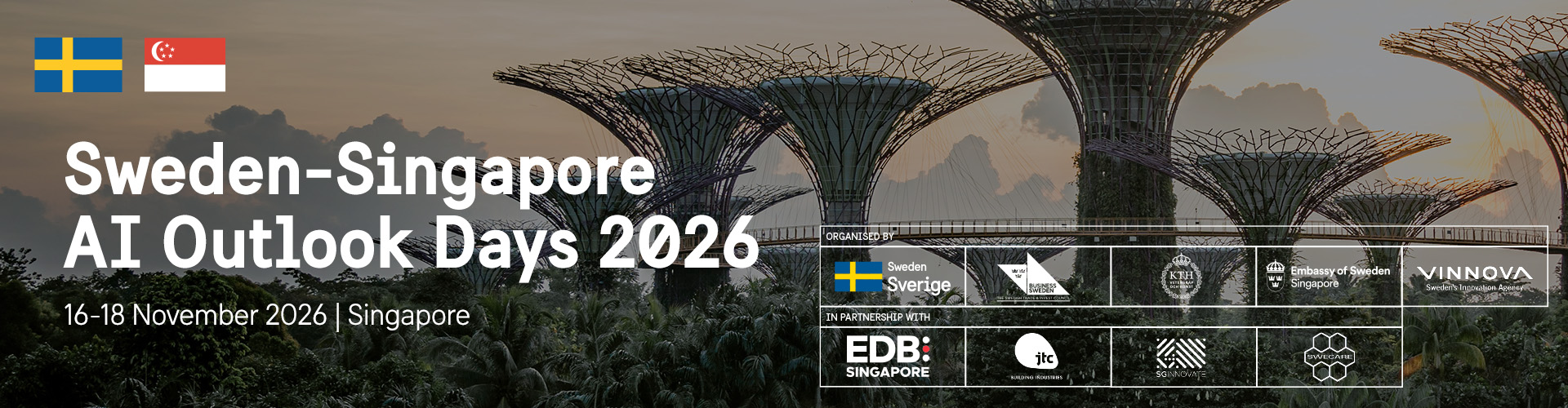
The academic track builds on the Sweden-Singapore dialogue on AI and the future of work, learning, and society. Bringing together researchers, universities, and policy-oriented actors, the programme explores how AI is reshaping education, labour markets, public institutions, and knowledge economies.
A particular focus is the meeting between two relatively similar knowledge economies with different approaches to AI, education, governance, and capability development. Sweden and Singapore share strong innovation environments, advanced digital infrastructures, and highly educated populations, yet differ in institutional structures, policy traditions, and strategies for AI adoption. The track creates a space for comparative discussion and mutual learning across these differences.
Academic track focus
Rather than viewing AI solely as a technological development, the academic track examines its broader societal and institutional implications. The programme connects research, policy, and education through comparative dialogue between Sweden and Singapore.
AI, education & lifelong learning
How AI changes learning, teaching, skills development, professional competence, and the future role of universities in knowledge economies.
AI, governance & policy
How public institutions, universities, and policy systems can respond to AI adoption while supporting human agency, democratic resilience, and responsible innovation.
Comparative Sweden-Singapore perspectives
How two advanced knowledge economies with strong innovation environments, but different institutional structures and AI policy traditions, can learn from each other.
Why this conversation matters
Sweden and Singapore are both highly digitalised, research-intensive, and innovation-oriented economies. At the same time, they approach AI, education, and capability development through different institutional models. This makes the academic track a valuable setting for comparative discussion: not because the countries are identical, but because their similarities make the differences analytically useful.
| Shared starting points | Swedish perspectives | Singapore perspectives |
|---|---|---|
| Advanced knowledge economies | Strong universities, industrial research traditions, and broad public-sector involvement. | Strong national coordination, applied research environments, and close links between policy and implementation. |
| AI and capability development | Often shaped by decentralised institutions, human-centred values, and broader lifelong learning traditions. | Often shaped by national strategy, scalability, employability, and coordinated skills development. |
| AI in society | Questions of democratic resilience, public trust, institutional adaptation, and the social contract. | Questions of implementation capacity, national readiness, public innovation, and rapid societal adoption. |
Indicative programme logic
The exact programme will be adapted to the participants and organisations represented in the room. Participants are encouraged to actively contribute perspectives, ongoing work, and emerging questions related to AI, education, policy, and societal transformation. A more detailed programme, including speakers and session titles, will be published closer to the event.
Research presentations
Short presentations of papers, projects, and ongoing research from Swedish and Singaporean academic environments.
Comparative discussion
Structured dialogue on what Sweden and Singapore can learn from each other in AI education, governance, and capability development.
Future collaboration
Exploration of future academic cooperation, joint publications, research projects, institutional partnerships, and policy-oriented initiatives.